Showing posts with label build credit. Show all posts

Friday, May 9, 2014

You have your high school diploma. Now what’s next?


You got your diploma, went to grad night, and stayed out until morning. What are your plans? You may have plans for college locally or away. You may have a job lined up for the summer. That’s what’s next for you, but what’s next for your money?

1. Have you opened a checking account? Was it at a bank or a credit union? If you opened your account at a commercial bank, you must enjoy paying fees to the bank. If you don’t enjoy paying fees to a bank, you can open your checking at a credit union and keep more of your money. It is not that credit unions don’t charge any fees, they just charge fewer of them than the banks do. Are you required to have a minimum balance in your bank account to avoid monthly service charges? Are you required to have direct deposit for a free checking account? If you don’t maintain these things, how much is the monthly charge? $10? $15?

Generally, at credit unions that is not the case. Most credit unions often offer checking accounts that are free of fees. There are no monthly service charges or minimum balance requirements. Direct Deposit is encouraged but not a requirement for a free account. Credit unions believe it is better for their members to keep their money than to take it from them in the form of banking fees.

2. Are you working? Then you should be saving money. Save what you can afford. If you have a car, you will thank yourself for saving some money. Cars don’t take care of themselves. Tires will go flat, batteries will go dead, hoses will spring leaks, and belts will break, all costing you money. Put some money away for that inevitable day when something goes wrong with the car. Just to tow your car five miles may cost you $100! Do you have $100 in your savings today? If not, you should have that as a minimum start amount and keep saving.

While we are working on savings, let’s talk about an emergency fund. As time goes by, an emergency fund will be important to you. A general rule of thumb for an emergency fund is six months worth of income. The emergency fund exists to fill gaps in your budget when unexpected expenses arise. Not just for fixing your car, but for emergencies such as getting transportation to visit sick family members, or your own emergency medical bills, or paying for your insurance deductible after a car accident are just some examples of good uses for your emergency fund. That emergency fund exists in case we find ourselves unemployed. That six months income in the fund may be what we need to bridge our income gap between jobs! So what’s the best way to save? Try allocating a portion of your check into a savings account as part of an automatic deposit or transfer. Think about it. If you get paid twice a month, that’s 26 checks in a year, if you only took $10 per check and had it automatically deposited into your savings, that’s $260. Now what if you doubled that to $20 per check? That’s $520 you’ve saved! And since it’s being automatically deposited, you probably won’t even notice it coming out of your check.

3. Do you have credit? Pay your bills on time so you don’t incur any bad credit and to help build strong credit. An unpaid bill can become a collection and hurt your chances to access credit. A cosigner can be very helpful in accessing credit such as a car loan or credit card. The cosigner is on the loan with you so they would suffer if you fail to pay on time. The cosigner is essentially putting their good credit at risk to help you. This should be treated with great respect. You must stay on top of any credit commitments made with a cosigner.

Are you more independent? Don’t want a cosigner? Perhaps a secure Visa or Master Card is in your future. Meriwest Credit Union (as well as many other CU’s) offers a secure Visa card that can be started for as little as $300. Send a $300 check with your application and, if approved, your will receive a $300 Visa credit card. Want a higher credit limit? Increase your security deposit. Your incentive is that if you don’t manage the card well you are putting your savings at risk. If the card is not paid on time, it could be closed and paid off with your secured savings. You would receive whatever is left after pay off. Be aware that these cards usually have an annual fee as well.

Whether you initiate credit with a cosigner or through the secured route, it will take some time to get yourself established. Rome was not built in a day and we don’t build a credit history in three months! Check CreditKarma.com to see your credit score and watch it grow as you manage your credit.

4. Do you have a car? Do you have adequate car insurance? There are a lot of car insurance companies that advertise very low rates and for good reason! They mainly quote the cost of the California Minimum Insurance. What are those minimums?
$15,000 for injury/death to one person.
$30,000 for injury/death to more than one person.
$5,000 for damage to property.

Let’s say you bought this exact amount of insurance. It is very inexpensive. Why? You have very little insurance. Let’s suppose you hit a new Mercedes Benz E-Class sedan from behind and the owner gets a neck injury like whiplash. If the car is totaled, it will cost you over $50,000 to replace it. How much do you suppose the hospital bills would be for whiplash? $100,000? $250,000? Whoa! More than that? Yep.

In this case, your insurance company will give the victim $5,000 for the damage to their car and $30,000 for the hospital stay. You are on the hook for the rest of it and it could be in the hundreds of thousands of dollars. If you don’t have hundreds of thousands of dollars in your emergency fund, you might want to budget for adequate insurance. It may cost you more than the super cheap minimum insurance, but it will help you sleep at night knowing you are not at risk of filing bankruptcy for a car accident.

These four things, opening a checking account, starting your savings, establishing your credit and properly insuring your car can make your financial life so much easier and put you ahead of the game. Many college graduates are not ready for their lives financially when they leave college. If you start your post high school planning with these four simple ideas, you can build a financial foundation that will serve you and your future family for the rest of your days.

*   *   *
All About Business Credit Cards
On Wednesday May 14th at 10 am PDT the Credit Union Guy, Meriwest CU's Community Relations Manager, Greg Meyer, will take part in a Google+ Hangout with the team at Credit Cards.com to talk about understanding Business Credit Cards. It's fifteen minutes that will bring you up to date on the differences and the proper uses of a business card. Here is the link to watch: http://bit.ly/1i20MX4 .

Free Credit and Identity Theft Workshops

Preventing Identity Theft
Wednesday, May 21, 2014 - 6:30-7:30 p.m.
Chesbro Financial Center, San Jose, CA
Identity theft is on the rise. After the Target Store breach, what more can we expect and how do we protect our hard earned money from these thieves? We share some answers with you.

Credit Myths & Credit Repair
Wednesday, May 28, 2014 - 6:30-7:30 p.m.
Chesbro Financial Center, San Jose, CA

Do you know all there is to know about credit? We review the top ten myths of credit and explain how paying bills, collections, credit inquiries, and divorce can effect your credit standing.


Friday, February 28, 2014

Minors with Credit Cards-Good idea?


As minors cannot sign a contract until they are 18 they cannot be involved as a co-signer on a card. A parent cannot cosign for their kids as the kids cannot sign on to the card with them. Cosigning for your kids is a relatively straightforward process, both of you will be on the application and both will sign. The parent’s credit will be evaluated for approval. If it is approved, the proper management of the card and the parent’s credit background will elevate their adult child’s credit score. Of course, if the card is not managed well or the parents have a lapse in managing their credit, that can be detrimental  to the young person’s credit score. 


However, being younger than 18 does not lock a young person out of having a credit card. They can be placed on an established credit card as an authorized signer. This gives them all the rights of usage without the responsibility. But it will start to build their score for them provided the parent has a good score to start with. Yes, the minor can start building that FICO score while they are a minor. The best option:  Parents can remove the minor from the account anytime they wish! 
 

This is especially helpful when the card has been misused.

 
The major disadvantage of minors with credit cards is their occasional lack of responsibility. They might use the card for parentally unauthorized usages like a Miley Cyrus concert or go hog wild buying MP3’s on iTunes or Amazon. There are a variety of opportunities for minors to misuse a card. It is up to the parent to ensure the child understands the limitations and responsibilities related to managing the card and teach them how their current authorized usage will benefit them in their adult life.

 
One option that families have in training their kids to manage money is the Meriwest Credit Union Flow Card. The Flow Card is an electronic checking account (no checks allowed) that is managed by a parent and their child. Flow Cards come with free online banking, online bill pay, and mobile banking options. Your child cannot overdraft a Flow Card! The account is ideal for those students who are aged 13-24 years old. It gives parents an opportunity to teach their kids about managing money with a debit card as the parent and the kid will both have access to the account information. This is good training for eventually managing a credit card.

 
Meriwest Credit Union is an Equal Housing Lender. All accounts are insured by the NCUA to $250,000.

Friday, October 18, 2013

Should I close a Credit Card? Will that hurt my credit score?


A question I hear often is, “Should I close out old credit cards that I don’t use anymore?” Is that a good idea? First we will talk about why closing a credit card may not ever be a good idea and then we can look at some reasons to close out a credit card.

Closing credit cards should never be taken lightly. Closing a card removes that available balance from our overall available credit. Removing these available balances by closing the cards can reduce our FICO/Credit score. 30% of your score is based upon the ratio of used vs. available credit. Reduce the ratio and reduce your FICO score.

Example: A person has $20,000 in available lines of credit and has $5,000 charged up. They are using 25% of their available credit; a 1:4 ratio of used credit to available credit. Then they close a credit card with a $5,000 available balance. This decrease in their available credit, from $20k to $15k, increases the percentage of credit they are using to 33% and takes them to a lower and less desirable 1:3 ratio in credit usage. This will lower their FICO Score.

Closing cards can be a big deal if consumer credit cards are your only form of credit. If you have other types of credit, a mortgage or car loan for example and have other credit cards, closing one card may not be a big deal. But if one has a thin or minimal credit file, it could be detrimental.Also, the history of your card usage will drop from the report after 18 months and it will no longer be a factor in your FICO score. Ouch!

Why close a card? Fees. Some cards have instituted annual fees; one must pay an annual fee just to possess the card. These annual fees can range from $25 to $100 depending on the card and its features (rewards, vacation insurance, travel services, etc.). If the fee is too much for you to afford or you just won’t pay it on principle, then it might be time to look for a new card to replace this one or close it altogether.

Interest rates can be an issue for people who carry balances. An increase in the APR of 3%, say from 15% to 18%, can cost a cardholder an extra $150 over a year on a $5,000 credit card balance. If the APR is a concern, I would recommend finding a lower rate replacement. Credit card issuers will often offer reduced rates for balance transfers. This may be an opportunity to transfer the balance to a new card with a lower rate and close the old card.

The card has been stolen or compromised by an identity thief. Good reason to close it. Often your card issuer will offer to replace the card with an entirely new account, transferring your balance to the new account.

Sometimes people get tired of making payments and are simply through with debt. They will cancel their cards to prevent further accumulation of debt. If you are ending your relationship with debt, that may be a good reason to close a card or two. That being said, keep one general purpose card such as a Visa or Master Card open for emergencies. Go to McDonalds once every six months and buy yourself a Happy Meal for lunch. Pay that bill at the end of the month and your card will remain active. Do this every six months to keep that card active. You never know when you will need it! 

*   *   *   

Our next Financial Education workshop will be taking place at our Sunnyvale Financial Center at 563 E. El Camino Real in Sunnyvale, next to Togo's Sandwiches. To attend, please RSVP with Greg Meyer at gmeyer@meriwest.com or 408-365-6328.


Credit Myths and Repair - Learn how to access your credit report from all three credit bureaus and your credit score for free. How do inquiries effect your score? What happens to your credit after you pay a collection? Have a late payment? Get a divorce?

6:30PM - 7:30PM on Oct. 23rd 

Sunnyvale Financial Center


Meriwest Credit Union

CAR SALE!!!

 November 9th and 10th at the Meriwest Credit Union Main Office 

5615 Chesbro Ave, San Jose CA 95123

Come to see our wide selection of late model, gently used cars offered at bargain prices by our MCU approved dealers.


Friday, July 26, 2013

5 Things New College Grads Should Know About Money and Credit


Let’s start with five things every new college graduate should know about money and credit. We will end with a few words of advice for new grads facing an uncertain economic future.

  1. Everyday, more and more employers are now looking at credit reports as a condition of employment. If you are responsible with your personal credit, you will likely be a responsible employee. Manage your credit well and enjoy the low rates and easy availability of money good credit management brings. You will want this when you buy a car or a new home.

  1. Review your credit report annually! Reviewing your report annually for free at AnnualCreditReport.com can keep you abreast of your personal credit situation and help you spot Identity Theft.

  1. Paying Bills: Very simple, your utilities need to be paid on time just like your credit card bills. Sure, you can let your light or water bill float for a couple of months and paying them 30 or 60 days late won’t count against you. As a matter of fact, you have 89 days to make your payment and have your account reinstated. However, if you wait to that 90th day, you are now delinquent. Your water, light, or phone bill amount will now be placed in collection and exist as a negative item on your credit report for seven years whether you pay it or not. (Paid collections remain on our credit reports for the balance of the seven years after payment as a reminder to others that you were irresponsible once or twice or repeatedly depending on how many collections one has.)

  1. Social Security: Social Security will exist in a very different format for these Gen Y students. They need to be self dependent and plan for their retirement early. No one will do it for them. In my workshops, I often ask who wants to retire with a million dollars in their retirement account. Of course, multiple hands go up. The point: When your employer offers you a 401k, pension, or any other type of “qualified” retirement plan, simply say “YES!” Start contributing to the retirement account. Put in at least 6%. You won’t miss it, you will save a few dollars on your taxes, and you will be pleasantly surprised when you get your retirement account statements and see it growing. This is especially gratifying if your employer matches your contribution or provides pension plan contributions from profit sharing.

  1. Social Media: Restrict your personal information that is shared over the internet. Too many young adults share too much as it is and do not take proper advantage of privacy controls in websites like Facebook. If you don’t want your next potential employer to see your spring break photos of drunken debauchery in Palm Springs or Palm Beach, tighten up your privacy controls, Dude!

I think following these five ideas can save you from living in your Mom’s basement forever.

In my work with recent college students and grads, one of their greatest fears is that they will never own a house. Recent grads are facing a difficult time in some areas with the homes they may want to buy being priced out of site for them due to the current demand. Don’t worry. The average age of a first time homebuyer is 30 years old. Most people I know did not buy a home until they were well into their 30’s. There is no rush to buy a home despite the increases in overall prices. You have time to save your money. You have time to evaluate where you want to live and whether a house or condo would be best for you. You have time to gauge the economy and pick your best time to buy.

I have noticed it and it has been expressed to me by some students, the financial markets are too volatile. Why would they want to put their money into the stock market? They fear the return of the great recession. When I was 21 in 1981 there was a recession on and it was pretty serious. Interest prime rates had risen over 20%. No one could get a decent interest rate to buy a home. Unemployment was 8% and rose to 10% over the next two years. In the early 80’s, we had many of the same fears today’s grads suffer.

What happened? Eventually, markets went into recovery. Unemployment was under 6% by 1988. The stock market doubled, tripled, and eventually grew to 14 times its size by the present day. This didn’t happen in a nice even fashion. It took a market crash in 1988 (22% drop in the Dow in just one day!) and three recessions in 1992, 2000, and 2008 to get here. Financial markets are cyclic and, historically, have always recovered and surpassed previous high water marks. 

*   *   *

Don't forget to "Like" us on Facebook: http://www.facebook.com/MeriwestCreditUnion

Friday, July 12, 2013

10 Financial Infographics and a Blogger


Today, we are full of links!

Info graphics have become a big rage on the internet. They can be very useful in explaining fairly complex issues in a series of “Powerpoint” like graphics and text that can be found on one page. Wikipedia says they can improve our cognition by utilizing graphics to enhance the human visual system’s ability to see patterns and trends; a data visualization so to speak. I like them because the read fast and always leave an impression.

Here are ten infographics I found that have some very important information in them that everyone could use. I will comment a little on each…


Love and Finances. How much does love cost? It might be more than you think.

How much do Americans Save? There are a lot of demands on our wallet! As savers, how are we ranked against other countries’ savers?

Protect your Identity Online. These are simple tips anyone can use to protect them from scammers. You are only safe if you take action. No one will do it for you!

What are capital gains? If you are unsure or don’t know at all, this graphic is a terrific explanation. It is better to know now than learn too late. That could be a costly tax mistake!

How finances impact emotional well being. Do you get depressed at the end of the month when your account runs low? Do you ever get the “Day before Pay Day Blues?”

How much can you save with a Roth IRA? This is surprising! Had I started in my 20’s I would have a huge tower of beer or a huge retirement account if I invested in dollars rather than beer. This is a fun and informative graphic.

It is important for us to plan for a long retirement. If you and your spouse were 62 today, there is a 47% chance that one of you will live to age 90. Have you planned your retirement accordingly?

Do financial challenges cause divorce? Earlier, we saw the costs of love in our Love and Finance graphic. But can money also cause a divorce?

What is a credit union? This info graphic lays it out nicely for us.

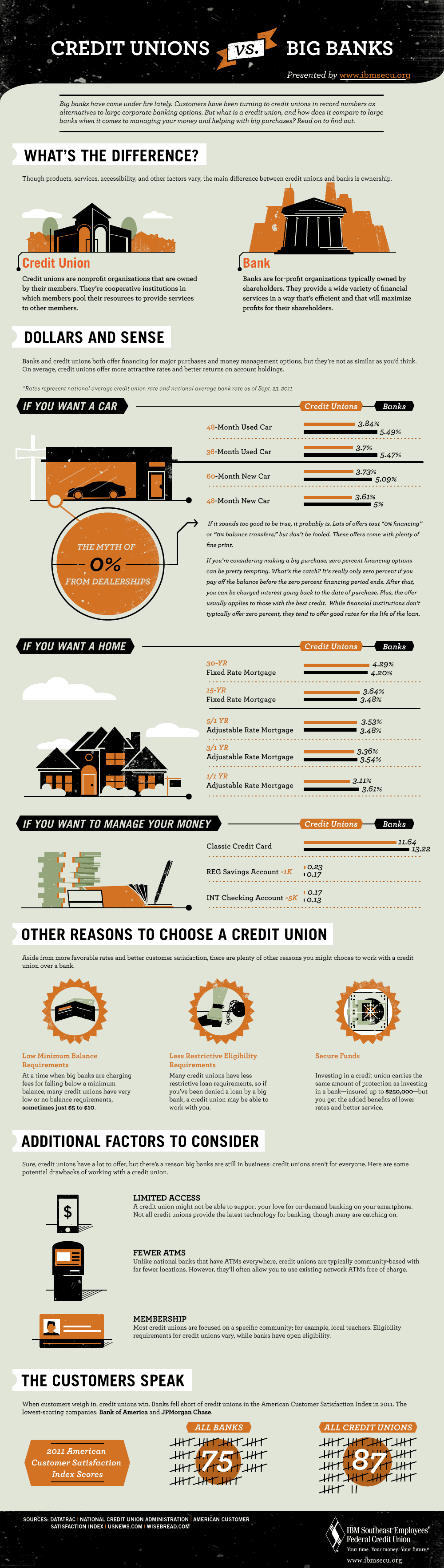
Credit Unions vs. Big Banks. The battle between the heavyweight champ (big banks) and the flyweight contender (credit unions) goes on. Where would you rather keep your banking?


*          *          *

Len Penzo is an electrical engineer with a good head for personal family finance. He is a recommended blogger by Kiplinger Reports who named him one of “Kiplinger’s Personal Finance Best Money Blogs.” I like to read Len’s blog weekly.

What I like best about Len’s blog: “Well, my blog is all about being personally responsible – not only for our personal finances, but also for everything else we do in life.  As you will learn from my blog, the great thing about financial freedom is that anyone can attain it — regardless of income level!”
http://lenpenzo.com/ Len Penzo - Finance Blogger

*          *          *

Don’t forget that this weekend is the Summer’s Hottest Car Sale!!!

The parking lot at our main office will be filled with recent model pre-owned cars this weekend. We have some outstanding financing deals for those who qualify.

July 13 - Saturday from 9am – 6pm
July 14 - Sunday from 10am to 5pm

Meriwest Credit Union Main Office
5615 Chesbro Ave
San Jose CA 95123

Don't forget to "LIKE" us on Facebook: http://www.facebook.com/MeriwestCreditUnion

Federally insured by NCUA. We do business in accordance with the Federal Fair Housing Law and Equal Credit Opportunity Act.
Copyright 2013 Meriwest Credit Union. All rights reserved.

Friday, April 12, 2013

A History of FICO Scores and Why We use them - Part One


We have spent a lot of print on what goes into creating your FICO score. We know who FICO is, Fair Isaac Company, and they invented the score. We have learned the five factors that go into it; Payments, Balances, History, Inquiries, and Types of Credit and how each of these factors are weighted. We have learned how FICO scores are affected by debt and collections. What we have not covered is why FICO exists at all. Why do we need FICO Scores?


Back in the day, we used your entire report, read it page by page, to learn how you manage your credit. We would check your collections, payment histories, and other data in making a lending decision. It took time to make loan decision. It was not like today where lending decisions can be made instantaneously online or within 24 hours of receipt of the application. Often, two or three people would have to review a loan file before it could be approved. That all changed with the advent of the FICO Score in the 1950’s.


Okay, so FICO saves us time in getting loan approvals. How did it come about?


In the 1860’s, a few regional credit bureaus started to crop up. They maintained lists of people or businesses that used credit and kept a record of their credit volume and payment histories. This allowed merchants to give credit to their customers without having to have a personal relationship with them as had been customary in the past.


In 1898, the first national credit bureau opened its doors. The Retail Credit Company, later to be known as Equifax, was born in Atlanta. For $25, merchants could get a list or “Merchant’s Guide” that listed those who were known to have good credit habits and would be a good credit risk. For many years, the Retail Credit Company (Equifax) would be the only game in town, and in the USA for that matter, where financial institutions and other lenders could gather information to judge risk when lending.


In 1900, the first versions of a credit card were issued. “Proprietary Cards” were issued by oil companies and department stores to good customers. This allowed these customers to purchase goods and pay them back at a later date. The cards were only accepted at the issuing store. While modern credit cards are issued for consumer convenience, “Proprietary Cards” were issued as a means of stimulating customer loyalty.


What about the other two credit bureaus? Where did they originate? In 1866, UTLX started doing business. They were a manufacturer of tank cars to be pulled by trains. Later, they started their own credit bureau and were known as TransUnion. In  1901, the Cleveland Cap and Screw Company was founded and that was later to became known as TRW and, eventually, the Experian Credit Bureau we know today. These companies, TransUnion and Experian, started tracking consumer credit usage in the 1960’s.


Between World War II and the advent of the other two credit bureaus in the late 1960’s, there was an explosion in credit! Prior to WWII most lending was local; merchants provided credit to local families or businesses. Many loans were made on the basis of bank references and personal recommendations. During this time, the ability to check someone’s credit on a nationwide basis had not been established.


As G.I.’s returned home after the war, the job market expanded and the demand for consumer products and home purchases grew dramatically. Loan volumes grew and financial institutions hired large numbers of loan processors and loan underwriters. As volumes grew, processing times got longer and customer patience was shorter.  


Finally, someone asked the question, how can we judge someone’s credit without having to read the entire credit report?


Check out Part II of our History of FICO Scores coming in next week!


 *   *   *
Workshops!
This month's Financial Education Workshops are taking place at our Monta Loma Financial Center in Mountain View: 580 North Rengstorff Ave, Mountain View CA. Please RSVP for either of these workshops at this link.

Auto Financing 101       April 17th at 6pm    Monta Loma Financial Center
Learn what insiders know about the auto buying process. What tricks do dealers use to get you to buy? Is my interest rate negotiable? How do I get the best deal on a purchase and financing? Meet our Personal Auto Shopping Service Manager, Bill Fultz who has 25 years of experience at car dealerships and now shares his knowledge with our members. 

Credit Myths and Repair    April 24th at 6pm   Monta Loma Financial Center

Learn how collections, credit inquiries, and late payments effect your credit score. What is a FICO score? You will learn how to access your credit report and your credit score for free.


Friday, November 30, 2012

Alternative Credit Scores


Over 70 million adults in the U.S. do not have a credit score or have a very limited credit history. Individuals and families living with limited credit files are forced to take advantage of alternative financial sources to cash their checks or get temporary short term loans aka Pay Day Loans. Users of alternative financial sources generally pay very high costs in relation to the usual transactions you might perform at your credit union. Cashing a paycheck could cost $3 - $15. A two week $200 payday loan could cost as much as $45 if paid on time. If the loan cannot be paid off right away, it has to be renewed. In California, that means the loan principle and interest has to be paid and a new loan created. How many times will a person have to pay $45 to maintain and renew the loan until they can afford to pay it off completely?

Several companies have created alternative credit scoring products based on the analysis of non-traditional data, including rental and bill payment history, insurance payments, debit-card use and public records. They are trying to use this data to predict the payment history of people who don’t have access to traditional credit products that can be tracked through a FICO score.

That is basically what a credit reporting bureau does for people with their credit. It reports the usage of the various forms of credit a person has and tracks the payments made and balances carried. Through a computer algorithm it creates a number that can predict, with fair certainty, the future payment history of an applicant. Those with FICO scores over 740 are more likely to make their payments on time and manage their outstanding balances better than someone with a score of less than 740.

Why do some people want to use alternative credit data? There is a profit motive as vendors can sell more products and services if there is a universe of more qualified buyers. It could also help families struggling with traditional credit by showing their propensity to pay their rent, utility bills, auto insurance, and other regular payments. By using alternative data, lenders stand to reach a large group of potential borrowers about whom they currently have little or no information. For these consumers, alternative credit scores strengthen lenders’ ability to:
-         Reliably rank order risk;
-         Efficiently evaluate applicants for credit or design offers for credit;
-         Increase approval rates while controlling for acceptable levels of risk

Meriwest works exclusively with Experian Credit Bureau. Experian offers various forms of credit reports. We use three specifically:

-         For all auto lending, direct lending to our members and through the Credit Union Direct Lending (CUDL) Network we use the FICO Auto 2 score. This is provided by Experian, and is a variation of the basic FICO score – more heavily weighted to the existence and performance on previous auto loans compared to the traditional FICO score.  This is similar to the “Auto Industry Option Scores” listed below.
-         For our other consumer loans, we use a custom score from Experian called a “Fast Start” score.  It is based on credit and personal characteristics such as their time on the job, how long they have been a member, and other data.
-         We also look at the Experian BK (Bankruptcy) score.  This is a predictor of the applicants likelihood of filing (or needing to file) bankruptcy, and is used as a risk measurement in our analysis.


We don’t use alternative scores, but do tend to look at our borrowers differently than a traditional bank. In a traditional commercial bank, credit score lending is King. If they are looking for a FICO score of 740 or above and that’s where you score, your application has a preliminary approval pending review of debt and income. If your FICO Score comes in less than 740, your application will be declined due to credit. They will take no further action on your behalf outside of sending you the decline letter.

Credit unions, in general, take a more holistic view of their borrowers. Sure, the FICO score is an important part of the loan qualification. Credit Unions would like to see a 740 FICO Score just like the big banks. But if you miss the score by this much (thumb and forefinger showing an inch), you may still qualify for a loan at a credit union. Why? They look at the whole person, not just their credit score. They look at how long you have been employed in the same business or the same employer. How long have you lived in the area? Or at the same home? How long have you been a member of the Credit Union? Have you borrowed from them before? All of these questions go into making the credit decisions. I am not saying that everyone with a less than 740 FICO Score gets a loan. But, if someone misses the target score by ten or twenty points, it is not the end of the loan. Credit Unions can take these questions into consideration and possibly make the loan for them at a slightly higher rate. This is called, Risk Based Pricing. If there is increased risk in lending to someone, say a 720 vs. a 740 FICO Score, we can price our interest rate a little higher accordingly to offset the risk.

Here is a run down of the more common credit scores and alternatives to credit scores:

FICO Score: Created by the Fair Isaac Corporation, FICO is the best-known credit scoring system in the United States. It is a way of measuring an individual's creditworthiness. A FICO score is a quantification of a variety of factors in an individual's background, including a history of default, the current amount of debt, and the length of time that the individual has made purchases on credit. A FICO score ranges between 300 and 850. The higher the score, the more likely that individual will pay their bills in a timely manner.

Vantage Score: A consumer credit rating product developed by three credit rating agencies - Equifax, TransUnion and Experian - as an alternative to the FICO Score. VantageScore uses a different rating scale (501 to 990) than FICO (300 to 850), and is branded as a score that provides lending institutions and banks information related to sub-prime financing. The score is calculated through a weighted average of a consumer's available credit, recent credit, payment history, credit utilization, depth of credit and credit balances.

Auto Industry Option Scores: Auto lenders are unlike other kinds of creditors. Many other creditors look at the entire credit picture to make a decision. However, some auto lenders base their decision solely on how previous auto loans were managed. So, even if your credit scores are bad, if you never missed a car or truck payment or sent one in late, your Auto Industry scores will most likely be higher than the standard FICO scores.

Veritas (by Digital Risk): Most recent alternative; used for home mortgage credit analysis. It Integrates borrower credit characteristics with property and local real estate market data along with proprietary behavioral prediction models. 

*   *   *

Our next Credit Myths workshop is this Wednesday the 5th of December
Credit Myths and Repair
6:30pm    Wednesday    December 5th 
Meriwest Credit Union Main Office
5615 Chesbro Ave, San Jose CA 95123
Click here to RSVP!


Thursday, August 30, 2012

The Costs of Bad Credit Part 2


The cost of bad credit can be very high; provided a credit issuer will give you credit. Last week, we looked at the costs of incurring bad credit such as late fees and higher rates. This week we will take a look at who may lend to a risky borrower and the extended cost of bad credit.

A credit score indicates to the lender the likelihood of a loan being repaid. The higher the FICO score, the more likely a loan will be repaid. Often times, those with low scores are offered a higher (AKA sub-prime) rate for car, home, and other credit purchases. It would not be unusual for someone with a low rating to be offered a 10-14% or higher interest rate on a used car loan when the prevailing rates for someone with a good credit rating would be about 7% or less. That was prior to the recent recession. Lenders are much more conscious of the defaults in subprime loans that have occurred over the past 5 years. Many have stepped away from the subprime market completely. Thus, for many lenders, either you qualify for a loan or you don’t. The subprime loan is no longer an option for many traditional lenders or many borrowers.

There are still some institutions that will lend to people with slightly less than perfect credit; they are known as credit unions. Why? Because credit unions take a more holistic approach to lending to their members. The FICO Score is important, but is not the only factor considered when lending. A credit union may require a higher down payment of subprime borrowers and/or ask them to pay a slightly higher interest rate. They will look at the applicant’s employment; how long have they worked for the same company? How long have they lived in the same home or neighborhood? How has the member managed their credit over the past 24 months? The answers to these questions may increase or decrease the interest rate or down payment.

As an example, let’s say a FICO score of equal to or greater than 740 is the target score for the institution and someone in that score range will get a rate of 2.99% for a new car loan with zero down. In this case, if someone misses the target by a bit, say the member comes in at 680, the credit union would likely make the loan with a somewhat higher rate than the base rate to help the member. Instead of 2.99%, perhaps the loan would be for 5.50%.

In this case, a car loan of $15,000 applied for a borrower with a 740 score and a borrower with a 680 score, there is a 2.51% difference in the loan rate (2.99% APR vs. 5.50% APR). The borrower with the 740 score will pay only $934 in interest over a 4 year period where the borrower with the lower score might pay as much as $1,745; a difference of $811 over the four year loan term. The borrower may not only be required to pay a higher interest rate, they may have to come up with money for an additional down payment. Subprime borrowers are often called upon to have a higher equity in their security than those with preferred rates. That is an additional cost to the subprime borrower. That is money that has to come out of savings leaving the borrower with reduced liquidity. Another cost is the loss of earned interest on the money used for the down payment. Let’s say the borrower has to put up an additional $3,000 in order to qualify for the loan, $3,000 in a savings account at 1% APY for 4 years would have earned $125. That’s better than spending an additional $800 in interest expenses.

Avoid these increased costs by managing your credit correctly.
  • Pay your bills on time and pay more than the minimum when possible.
  • Pay down outstanding balances.
  • Avoid using your entire credit available limit
  • Only apply for credit when you want it. Don’t apply for a card just to get a discount!
  • Read your credit contracts. Don’t get caught in a consumer trap. 
*     *     *
Are you planning on buying a home? This is one of the great times to purchase one. Loan rates are low and home prices are starting to rise!  If you are ready to buy, visit our next Homebuyer's Seminar here at the Meriwest Credit Union main office on Sept. 8th. Get all the details you need to finance your home purchase! 

Curious about rates? Here are some links to our current interest rates on consumer and home loans:

Auto Loans - New and Used

Home Loans

Equity Lines of Credit

Thursday, August 9, 2012

Benjamin Franklin's Legacy of Money Management


Benjamin Franklin is probably the Founding Father who was most financially aware. I have assembled some of his more memorable lines here and added my own explanation to them. As you read these quips, remember the age in which these were written. Back in the late 1700’s, it was frowned upon when one borrowed. Both Shakespeare and the churches warned people against lending and borrowing money.

Let’s keep in mind, in 1785 there were no consumer lending laws to protect us from predatory lenders. As more than two hundred years have passed since Ben was publishing his thoughts on financial education, there have been numerous changes in how we borrow and how lenders work with us. Today, borrowing to purchase a home or a car is fully acceptable. When credit is granted, it is done through a very careful approval process where a borrower’s income and past credit management is put under scrutiny.

But, just like in Ben Franklin’s time, it is not a good idea to go too far into debt

Let’s consider some of his sayings:

When you run in debt; you give to another power over your liberty. -  And  - The borrower is a slave to the lender, and the debtor to the creditor.
Meaning that when we are in debt, those who hold our debt control us and take away our freedom to a certain extent. While in debt, we are slaves to the monthly payment!

Rather go to bed supperless than rise in debt.
Franklin had a great disdain for being in debt. In those days, if you were in debt, the whole town knew it. He would rather be hungry than owe money.

Tis easier to suppress the first desire than to satisfy all that follow it.
This relates directly to “Wants vs. Needs.” Essentially he is saying, fight the urges to spend money. As you fight those urges, it will be come easier and easier to suppress the desire to spend.

For age and want, save while you may; No morning sun lasts a whole day. 
Save for your retirement and for the things you want. Start now, start early. There is no time like the present to begin. You have a limited amount of time to make a good return on your retirement funds.

Get what you can, and what you get hold; ’Tis the stone that will turn all your lead into gold.  
It seems that Ben Franklin also understood time and money. Saving your money in an appropriate investment can turn a few dollars into many or “what you hold into gold!”

Beware of little expenses; a small leak will sink a great ship.
Little things add up. It’s like two sodas from the coke machine everyday. .75 cents per coke, twice a day, five days a week, for fifty two weeks = $360! Could we find a better way to spend or save $360?

Buy what thou hast no need of, and before long thou shalt sell thy necessaries.
If you buy the stuff you want you may eventually have to sell the important things you need to pay for the stuff you want.

All of these things are as true today as they were 230+ years ago. It is not a good idea to go into debt. It is still a good idea to save. It is still a good idea to invest. It is a good idea to have a budget and adhere to it. This is timeless advice that we can all use.

But let’s also remember that not all debt is bad! There is debt that can help us. A loan on a home allows us to write off the interest that is paid annually, thus saving families thousands of dollars in hosing costs making that home more affordable for them. A car is a personal asset that gets us to work on time. So, a car loan can be considered part of an investment in our personal economic development. 

And for all of you out there looking for our next financial education workshops, your summer wait is over. Our next workshop will be "Reality Based Budgets for Teens" at our Milpitas Financial Center at 6PM on Aug. 22nd. 

Our next "Credit Myths and Repair Workshop" will take place at our Milpitas Financial Center on Aug. 29th at 6PM. 

I hope I will meet you at one of our seminars! Have a great week!