Showing posts with label auto purchase. Show all posts

Wednesday, November 27, 2013

When is 0% for a car loan not really zero??


Good Morning! Today’s blog is guest written by our Personal Auto Shopping Service Manager, Bill Fultz. Bill had over 20 years in the auto sales business before he came to work at our credit union. Here, Bill gives us an education on how a zero percent auto financing deal may not actually equal zero percent for the consumer and could cost them more than conventional financing.

*   *   *

This time of year, we make our members a lot of auto loans. One of the phrases we often hear is, “I can get Zero Percent financing at the dealership.” But, is Zero Percent financing really 0%? Do you save more money taking the car with the dealer’s 0% financing or would you be better off negotiating the price of the car including the rebate and taking out a loan from your local credit union?

Here is the dealer’s basic program: 0% financing for up to 60 months or you have the option of taking a rebate from $1,000 to $2,000 and find your own financing. Which one is the better deal for you? Let’s look at this 0% deal and compare it to a low interest Meriwest Credit Union 60 month loan with the manufacturer’s rebate applied.

Dealer loan:

$20,000 @ 60 months 0% interest = 60 payments of $333.33

Meriwest Credit Union loan after $2000 rebate is applied:

$20,000 minus $2,000 rebate = $18,000

$18,000 @ 1.99% * = 60 payments of $315.20 total interest paid: $925.20

$18,000 + $925.20 = $18,925.20

You save $1,074.80 ($20,000 - $18,925.20) with a Meriwest Credit Union loan

(This is an example. Your actual savings will depend on the size of the rebate on the Vehicle you purchase and the actual rate you qualify for at the Credit Union).

Besides the outright savings using your Credit Union loan, you also get that savings up front!  That means that even if you decide to sell or trade in your vehicle before the 60-month loan is paid, you already have saved the money when you purchased. 

If you decide the 60-month 0% is the better way to buy, also consider that in order to actually save the full amount you must keep the car the entire 60 months.  If you sell or trade before that time period, you have lost the value of the rate.  Statistically most 60 month loans are paid off by members in a period of 36 months, as members choose to sell or trade in their vehicles on a newer model and in some cases as a result due to an accident.  

Members who take the up front cash rebates are free to do as they please with regards to trade-in etc, since they are not forced to keep the vehicle for the full term of the loan in order to realize the advantage of low or 0 % financing.  So, if you are in the market for a new vehicle from a manufacturer offering large rebates or artificially low interest rates, contact a Meriwest Credit Union financial service representative to give you a comparison between a Meriwest loan and the Dealer’s.  You might find out that 0% isn’t really as good as it sounds!

About P.A.S.S.: Whether you're looking for a new or used auto, using P.A.S.S. means you don't have to deal with dealership salespeople. Instead, you work directly with Bill Fultz, Meriwest's Personal Auto Shopper and your very own insider in the automotive world. He has access to thousands of new and used cars in dealer inventories all over the state. Need a new or used car? Check our link at WWW.Meriwest.com/PASS for more info.


*   *   *

Our next Financial Education Workshop:

Credit Myths and Credit Repair
December 11, 2013 - 6:30pm
Meriwest Credit Union Main Office
Training Room
5615 Chesbro Ave
San Jose CA 95123


Please RSVP to Gmeyer@meriwest.com


Friday, July 12, 2013

10 Financial Infographics and a Blogger


Today, we are full of links!

Info graphics have become a big rage on the internet. They can be very useful in explaining fairly complex issues in a series of “Powerpoint” like graphics and text that can be found on one page. Wikipedia says they can improve our cognition by utilizing graphics to enhance the human visual system’s ability to see patterns and trends; a data visualization so to speak. I like them because the read fast and always leave an impression.

Here are ten infographics I found that have some very important information in them that everyone could use. I will comment a little on each…


Love and Finances. How much does love cost? It might be more than you think.

How much do Americans Save? There are a lot of demands on our wallet! As savers, how are we ranked against other countries’ savers?

Protect your Identity Online. These are simple tips anyone can use to protect them from scammers. You are only safe if you take action. No one will do it for you!

What are capital gains? If you are unsure or don’t know at all, this graphic is a terrific explanation. It is better to know now than learn too late. That could be a costly tax mistake!

How finances impact emotional well being. Do you get depressed at the end of the month when your account runs low? Do you ever get the “Day before Pay Day Blues?”

How much can you save with a Roth IRA? This is surprising! Had I started in my 20’s I would have a huge tower of beer or a huge retirement account if I invested in dollars rather than beer. This is a fun and informative graphic.

It is important for us to plan for a long retirement. If you and your spouse were 62 today, there is a 47% chance that one of you will live to age 90. Have you planned your retirement accordingly?

Do financial challenges cause divorce? Earlier, we saw the costs of love in our Love and Finance graphic. But can money also cause a divorce?

What is a credit union? This info graphic lays it out nicely for us.

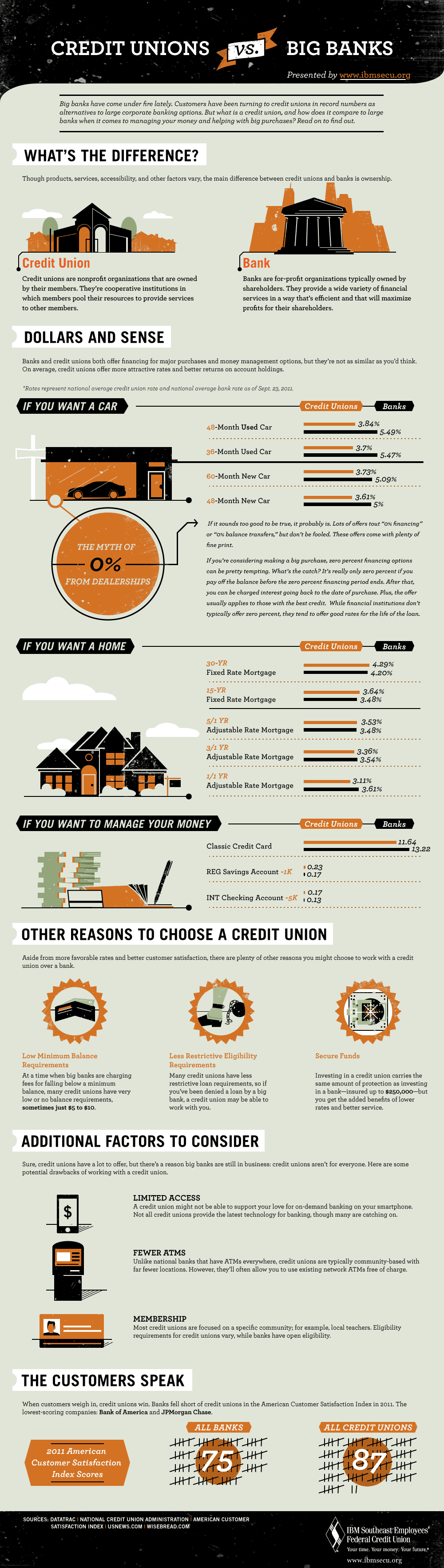
Credit Unions vs. Big Banks. The battle between the heavyweight champ (big banks) and the flyweight contender (credit unions) goes on. Where would you rather keep your banking?


*          *          *

Len Penzo is an electrical engineer with a good head for personal family finance. He is a recommended blogger by Kiplinger Reports who named him one of “Kiplinger’s Personal Finance Best Money Blogs.” I like to read Len’s blog weekly.

What I like best about Len’s blog: “Well, my blog is all about being personally responsible – not only for our personal finances, but also for everything else we do in life.  As you will learn from my blog, the great thing about financial freedom is that anyone can attain it — regardless of income level!”
http://lenpenzo.com/ Len Penzo - Finance Blogger

*          *          *

Don’t forget that this weekend is the Summer’s Hottest Car Sale!!!

The parking lot at our main office will be filled with recent model pre-owned cars this weekend. We have some outstanding financing deals for those who qualify.

July 13 - Saturday from 9am – 6pm
July 14 - Sunday from 10am to 5pm

Meriwest Credit Union Main Office
5615 Chesbro Ave
San Jose CA 95123

Don't forget to "LIKE" us on Facebook: http://www.facebook.com/MeriwestCreditUnion

Federally insured by NCUA. We do business in accordance with the Federal Fair Housing Law and Equal Credit Opportunity Act.
Copyright 2013 Meriwest Credit Union. All rights reserved.

Monday, May 14, 2012

7 Steps to Buying your First Car


Buying a car is often our first big expenditure and our first foray into the world of credit. Buying a car is not all about numbers, dollars, and cents; it is an emotional experience. It is that dream of rolling down the open road with the window down and our elbow resting on the door while we cruise along going somewhere in our car. That dream of buying a car is important, but equally important is the work that gets us to that point.  Your first car purchase is a major financial transaction and should not be taken lightly.

For many, a vehicle means freedom. But, it also means economic empowerment as it gives you increased job opportunities and increased earning potential. You will also have an improved quality of life. Some crosstown buses can take hours to reach their destination. With your personal car, you will have more quality time with your friends and family. Since you will be making a regular monthly payment on the loan, your car ownership is also an opportunity to improve your overall credit picture.

  1. Your first step in the transaction is to know how much of a car you can afford. Refer to your budget to see how much disposable income you have available after paying your rent and monthly bills. That is what you have available for a car payment and insurance.

  1. Do you know the condition of your credit? What's your FICO Score? First, get your free credit report at  WWW.AnnualCreditReport.com. This website is managed by the three credit bureaus and the Federal Trade Commission. You can access and printout your report from all three bureaus for free once a year. Yes, NO CHARGE.

  1. As for your FICO Score, you can access that at WWW.MyFico.com. MyFico.com is not free ($14.95 a month), but it will be the most accurate representation of your score that is available. If you cancel before the end of the ten day free trial, you will not be charged.
    1. Do you need a co-signer? Need to learn more about it? Check out our Co-Signer Blog from a couple of weeks ago.

  1. What have you saved for a down payment? The down payment is part of your purchase price. It determines the amount you will be financing. A significant down payment can decrease the monthly payment amount. The down payment also plays a role in determining your interest rate.   Often lenders will give you a better rate based upon larger down payments. A large down payment tells your lender that you have “skin in the game.” They will be more comfortable lending to you and providing a favorable rate if you have a personal investment in the vehicle they are financing. We offer the “You Name It!” savings account that is designed just for this sort of purpose.

  1. Once you are financially up to date, you can start researching the car you want to own.  What do you need? Good gas mileage? Sporty? Four Wheel Drive? Do you need a wagon or SUV for your family? Or is it going to be basic transportation? This is where you need to study and learn what the best and most affordable car is in your price range. Here are three excellent websites I am using to research my next vehicle purchase. Each of these has extensive information on the technical issues and the fair market prices of the car you may be purchasing.
    1. Credit Union Dealer Network  WWW.CUDLAutoSmart.com
    2. No. American Dealer's Association Guide  WWW.NADAGuides.com
    3. Edmunds Automotive  WWW.Edmunds.com

  1. Now we need to shop for vehicle financing. Credit Unions, banks, finance companies, and auto dealers all offer auto and truck financing. I am partial to credit union financing because I like lower rates, faster approvals, faster loan processing, and, a big reason I like them, discounted extended warranties for my car. I put a lot of miles on my vehicle. By financing my car through the credit union, I can buy the extended warranty at a huge discount over the warranty the dealer will sell. Once you have selected your lender, you should get pre-approved for a car loan. Then there is no doubt about how much car you can afford and it makes your purchase negotiation much easier!

  1. Now it's time to go to the dealership or private party and negotiate your best deal. The best negotiating tip I can give you is to stick to your budget. Dealers will try to egg you into a slightly higher payment for some options, “The premium stereo will only cost you another $15 per payment. Are you going to let $15 keep you from having the best stereo?” REMEMBER: $15 per month on a 36 month loan means you will pay the dealer $540 for that stereo. Stick to your budget and don't let the dealer try to sell you on the payment amount.

  • Meriwest Credit Union offers a full array of tools to help with your auto purchase decision. We have loan calculators, vehicle research, interest rates, and even a link to tell you the value of your trade-in.

Many of our members tell us that building their budget and getting their financing is the easy part of buying a car. It is negotiating the price of the car that seems to be the hardest part of the process. One option I have used in the past is an Auto Broker. An Auto Broker can find the car you want and often negotiate a good price for you as they bring large volumes of business to the dealership. But Auto Brokers charge for their services; sometimes well over $500 for high end vehicles. An option that some credit unions have for their members is an auto buying service or, as we call it, a Personal Auto Shopping Service or P.A.S.S.  It is an Auto Broker who works for your credit union and works for you for no charge! It's as if you have a friend in the car business.

If you are interested in our Personal Auto Shopping Service, please contact Bill Fultz at 408-365-6321. Bill has 25 years in the car business. Let Bill use his connections and expertise to get you the best deal.

Auto Sale at Meriwest Credit Union – Main Office

May 19th - 9AM to 5PM
May 20th - 10AM to 6PM
5615 Chesbro Ave, San Jose CA 95123

Get special dealer pricing and financing deals.

To get pre-approved for financing, call Meriwest Credit Union at 877-MERIWEST or online at Meriwest Credit Union Auto Loans.   

Upcoming event: Identity Theft
May 16th @ Meriwest Credit Union
Chesbro Ave. Main Office-Please RSVP with Greg Meyer at gmeyer@meriwest.com